
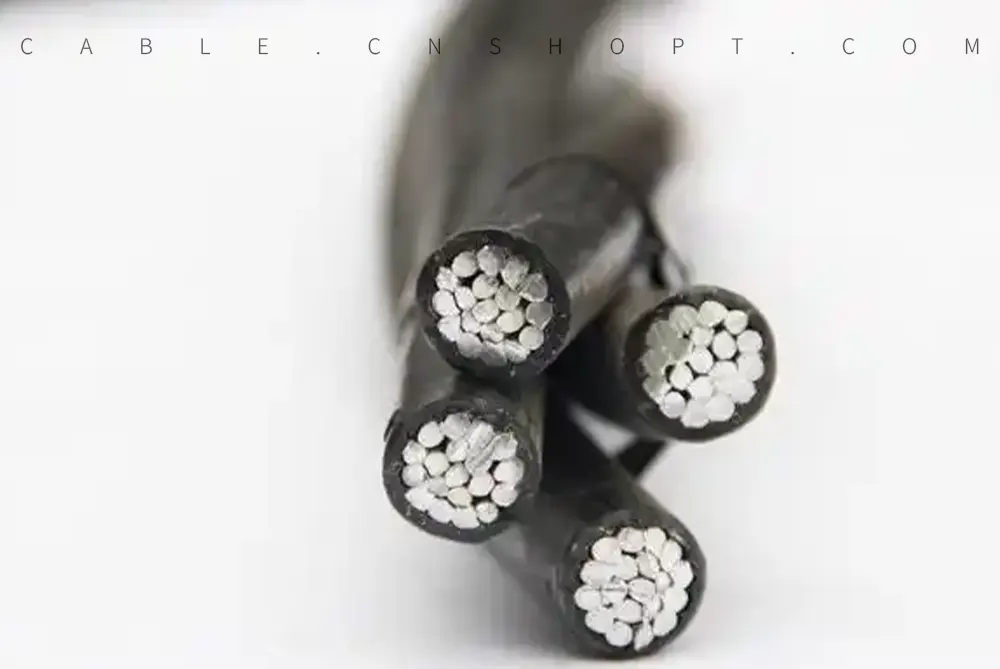
The neutral conductor in Aerial Bundled Cable (ABC) systems serves as the return path for current in a low-voltage distribution network and, depending on the design, often acts as the primary catenary (messenger) wire for mechanical support. Unlike traditional bare overhead lines, the ABC neutral is typically an insulated or bare Aluminum Alloy (AAAC) or ACSR core around which the phase conductors are twisted. According to IEC 60502-1 and NF C 33-209 standards, its cross-sectional area is engineered to handle both the unbalanced load current and the structural longitudinal tension of the span between poles.
The choice of neutral conductor depends on whether the system is "Self-Supporting" or "Messenger-Supported."
| Feature | Messenger Neutral (Type NF C 33-209) | Self-Supporting Neutral (Type VDE 0276) |
| Material | Aluminum Alloy (AAAC / AlMgSi) | Hard Drawn Aluminum (AAC) |
| Primary Function | Mechanical Support + Electrical Return | Electrical Return Only |
| Tensile Strength | High (Approx. 295-300 MPa) | Low (Approx. 160-180 MPa) |
| Insulation | Black Weather-Resistant XLPE / PE | Black Weather-Resistant XLPE |
| Common Sizes | 50mm², 70mm², 95mm² | Same as Phase Conductors (e.g., 4x25mm²) |
| Standard Compliance | IEC 61089 / NF C 33-209 | HD 626 S1 / VDE 0276 |
When specifying or installing ABC systems, the neutral conductor must meet strict mechanical and electrical tolerances to prevent line sag or phase failure.
Verify Conductor Material: Ensure the neutral messenger is Aluminium Alloy 6201 for high-tension spans. For short-span service drops, hard-drawn aluminum is acceptable.
Calculate Minimum Breaking Load (MBL): The neutral must withstand the total weight of the bundle plus environmental loads (wind/ice). A 70mm² AAAC neutral typically has an MBL of approximately 20-22 kN.
Ensure UV Resistance: The insulation must be Carbon Black stabilized XLPE (minimum 2% carbon content) to prevent degradation from direct solar radiation.
Bending Radius Compliance: Maintain a minimum bending radius of 12x to 15x the cable's outer diameter to avoid stress fractures in the aluminum alloy core.
Grounding Frequency: The neutral should be grounded at the transformer and at specific intervals (e.g., every 4th pole or at dead-ends) to maintain the TN-C-S or TT system integrity.
In many LV ABC configurations (especially French-standard designs), the neutral conductor is the only component under tension. The phase conductors are "bundled" around it but carry no mechanical load. This design reduces the risk of phase-to-phase shorts during high winds, as the mechanical stress is concentrated on the high-strength aluminum alloy neutral.
The neutral is sized to carry the maximum expected unbalance in a three-phase system. In modern ABC manufacturing, the neutral cross-section is often smaller than or equal to the phase conductors (e.g., $3 \times 70 + 1 \times 50 + 1 \times 16$). However, in high-harmonic environments, full-sized neutrals are recommended to prevent overheating from triplen harmonics ($3^{rd}, 9^{th}, 15^{th}$).
To ensure correct phasing during "hot-line" tapping or maintenance, the neutral conductor is physically distinguished by:
Ribbed Longitudinal Identification: Multiple raised ridges (usually 16 or more) on the XLPE sheath.
Surface Printing: Continuous marking of the standard (e.g., "IEC 60502") and manufacturer.
CNSHOPT team will generally respond to your message within eight hours. If it is a weekend or a Chinese statutory holiday, there will be a delay.
We prefer you to contact us via email : info@cnshopt.com. In case of emergency, you can directly contact our WhatsApp account. If you do not receive our reply within 24 hours, please check your spam mailbox, it may appear there. We hope you will add our email to your trust list.
