
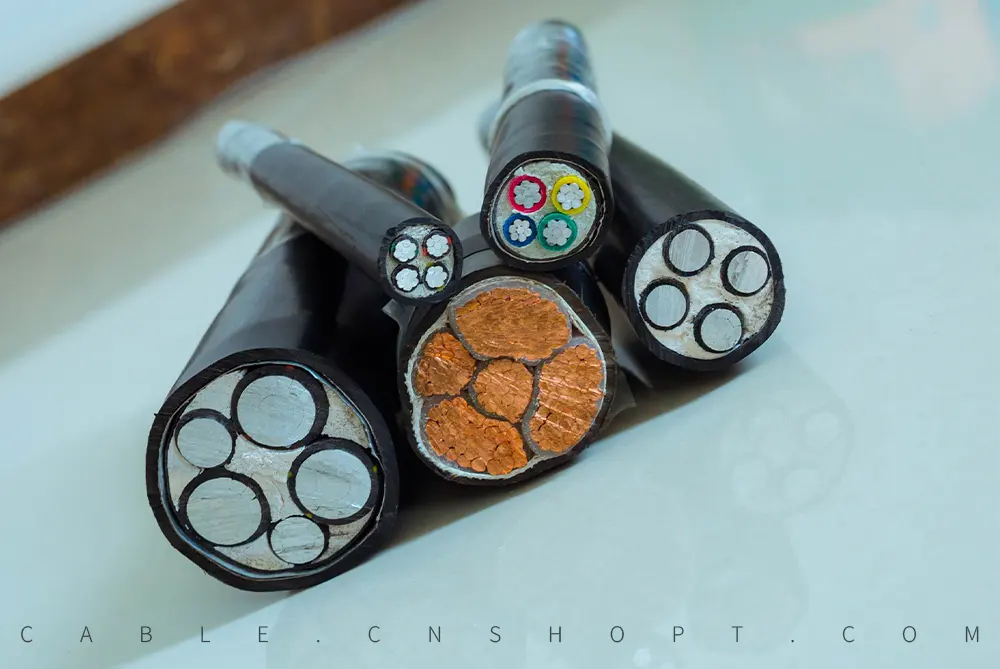
Copper core cables offer higher electrical conductivity (~100% IACS), lower resistance, superior mechanical strength, and better connection reliability, making them the preferred choice for critical, high-load, and space-constrained installations. Aluminum core cables provide lower cost and lighter weight (~50% of copper), but have higher resistance (~61% IACS), larger required cross-sections, and stricter termination requirements.
Conclusion: Copper is technically superior for performance and longevity; aluminum is economically advantageous for large cross-section feeders and overhead/long-distance applications when properly engineered.
| Parameter | Copper Core Cable | Aluminum Core Cable |
|---|---|---|
| Conductivity (IACS) | ~100% | ~61% |
| Resistivity (20°C) | ~0.0172 Ω·mm²/m | ~0.0283 Ω·mm²/m |
| Current Capacity | Higher (same cross-section) | Lower (needs larger size) |
| Tensile Strength | High | Lower |
| Weight | High | ~50% lighter |
| Thermal Expansion | Lower | Higher (more creep risk) |
| Connection Reliability | Excellent (stable contact resistance) | Requires lugs/anti-oxidation treatment |
| Corrosion Behavior | Good | Forms oxide layer (increases resistance) |
| Typical Standards | IEC 60228 Class 1/2/5 | IEC 60228 Class 1/2 |
| Cost | Higher | Lower |
Copper minimizes I²R losses, improving system efficiency and reducing heat rise.
Aluminum requires ~1.6× larger cross-section to carry the same current.
Copper: Better flexibility and fatigue resistance; suitable for tight bending and repeated շարժ.
Aluminum: More prone to creep and loosening at terminations; requires torque-controlled connections.
Copper maintains stable conductivity under ताप rise.
Aluminum exhibits higher thermal expansion, increasing long-term joint risk.
Define Load and Voltage Drop Limits
Maintain voltage drop ≤ 3–5% (IEC practice).
If space is limited → prefer copper.
Evaluate Installation Environment
Indoor, confined տարածք → copper
Overhead or long दूरी → aluminum
Assess Mechanical Requirements
High तनाव or vibration → copper
Lightweight պահանջ → aluminum
Check Budget Constraints
Large परियोजना with long feeders → aluminum reduces CAPEX
Verify Termination Method
ճիշտ լugs (bi-metallic)
Anti-oxidation compound
პერიოდական inspection
Aluminum requires:
Confirm Standards Compliance
IEC 60228 (conductors)
IEC 60502-1 (LV cables)
Determine Lifecycle Cost (LCC)
Include energy losses, maintenance, and failure risk, not just initial cost
Building wiring (residential/commercial)
صنعتی control and instrumentation cables
High-reliability systems (data centers, hospitals)
Overhead transmission (e.g., ACSR conductors)
Large cross-section LV/MV feeders
Utility توزيع networks
| Copper Size (mm²) | Equivalent Aluminum Size (mm²) |
|---|---|
| 16 mm² | 25 mm² |
| 25 mm² | 35 mm² |
| 50 mm² | 70 mm² |
| 95 mm² | 120–150 mm² |
Conductor Resistance Test (IEC 60228)
Crimping Quality Verification
Ensure no الهواء gaps in lugs
Torque नियंत्रण for Terminals
Follow manufacturer निर्दिष्ट torque values
Oxidation Protection (Aluminum)
Apply anti-oxidant paste
Thermal निरीक्षण (Infrared Scan)
Detect overheating joints during operation
Choose Copper When:
Space is limited
Reliability is critical
բարձր current density is required
Choose Aluminum When:
Budget is constrained
Cable लंबाई is large
Weight reduction is important
CNSHOPT team will generally respond to your message within eight hours. If it is a weekend or a Chinese statutory holiday, there will be a delay.
We prefer you to contact us via email : info@cnshopt.com. In case of emergency, you can directly contact our WhatsApp account. If you do not receive our reply within 24 hours, please check your spam mailbox, it may appear there. We hope you will add our email to your trust list.
